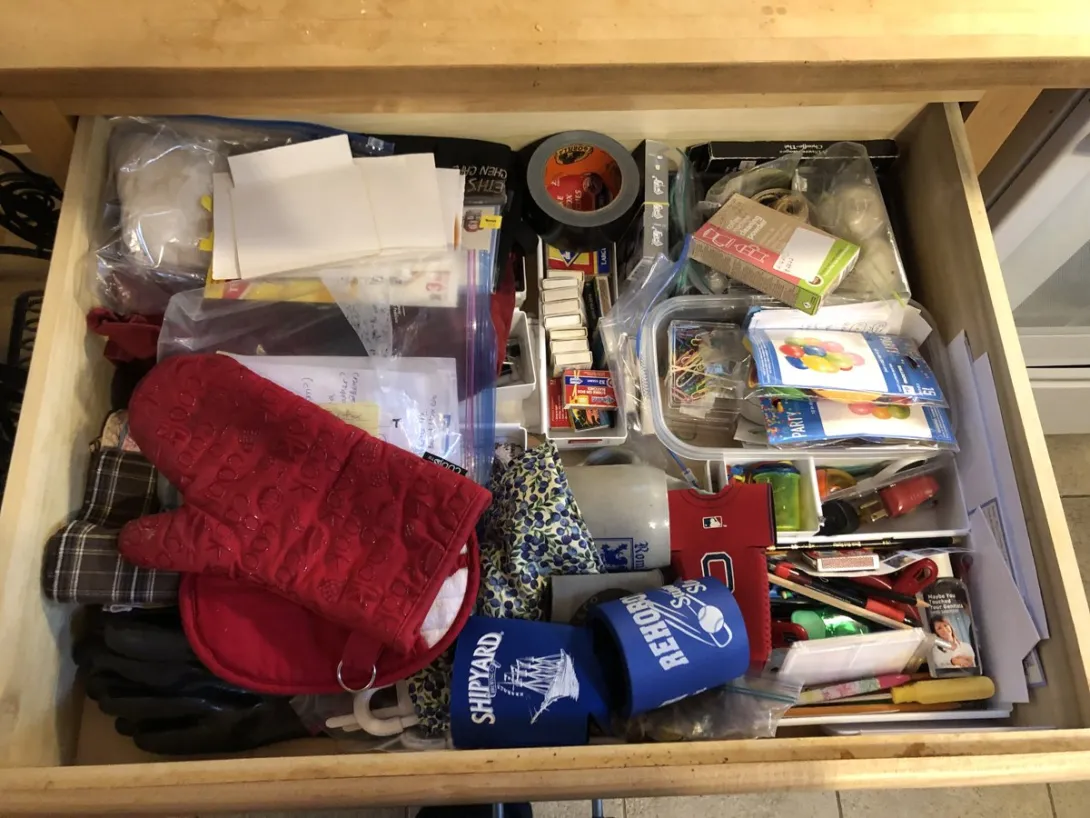
Every home has one. It is not on the floor plan and nobody admits to starting it, but the junk drawer is real, it is full, and it will not help you today.
You open it for one simple reason. You need tape, or scissors, or a working pen, or that one little screwdriver. What you find instead is an archaeological dig. Three mystery keys to locks nobody remembers. A charger for a phone retired years ago. Dead batteries rolling loose next to good batteries, now impossible to tell apart. Rubber bands, takeout menus, a single playing card, and instructions for an appliance you no longer own.
Everything in there was saved for a sensible reason at the time. That cable might fit something. Those extra buttons might match a shirt. That tiny Allen key definitely went with some piece of furniture, even if the furniture is long gone. Throwing any of it away feels like a guarantee you will need it tomorrow, so back in it goes.
The drawer also obeys a cruel sorting system. The thing you need is always underneath everything else, if it is there at all. You dig past string, spare change from another country, a flashlight with no batteries — see above, batteries, condition unknown — and a tape measure that only measures your patience. Your hand finds something sharp you cannot identify. You withdraw carefully and reconsider your life choices.
Then comes the negotiation phase. Maybe the scissors are in another drawer. They are not. Maybe someone moved the tape. Someone did, in the sense that no living person will confess to it. You check the junk drawer again, slower this time, as if politeness will persuade it to cooperate. It does not. The drawer has fifty useful things and none of them are today's thing.
Eventually you give up and improvise. You tear the package open. You use a kitchen knife as a screwdriver, badly. You write the note in a color you hate because that is the only pen that works. Problem solved, dignity dented, and the drawer wins again.
The worst part is what happens next. At the store, you buy the tape or the scissors you could not find. You bring the replacement home and, with nowhere better to put it, you drop it in the junk drawer. A week later you will open that drawer looking for it, and somehow — somehow — it will already be gone, buried under a fresh layer of almost-useful things.
So here is to the junk drawer: part toolbox, part museum, part trap. It promises preparedness and delivers a guided tour of every object you own except the one you need, right when you need it.