
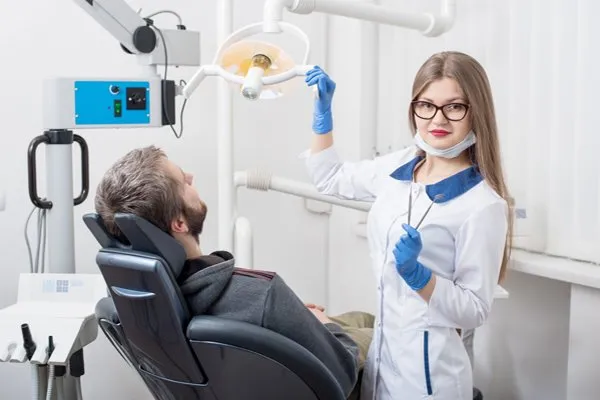
There is exactly one place on Earth where a professional will fill your mouth with metal instruments, a suction tube, and what feels like both of their hands, and then immediately start a conversation. That place is the dentist's chair, and the conversation always begins the second you lose the ability to have one.
The timing is perfect, every time. You are reclined at an angle normally reserved for astronauts. A bright light is in your eyes. Your tongue is pinned down by a mirror, your cheek is stretched by a gloved finger, and a small vacuum is slurping in the corner of your mouth. This, apparently, is the ideal moment to ask where you went on vacation.
And it is never a yes-or-no question. Dentists do not ask, "Are you comfortable?" They ask, "So, did you drive or fly?" They want details. They want to know how the kids are doing in school, what you do for a living, whether you liked the hotel, and if you would go back. Meanwhile, the sum total of human language available to you is "uh-huh," "mm-mm," and a noise that sounds like a seal asking for help.
The cruel part is that they understand you. Somehow, through years of training that dental school never advertises, dentists become fluent in Mouth-Full. You gurgle something that should be medically concerning, and they nod and reply, "Oh, Cabo? We loved Cabo. Did you do the snorkeling?" You did not say Cabo clearly. You barely said it at all. Yet the conversation rolls on, with you contributing what amounts to polite drowning sounds.
Then comes the follow-up question, which requires an actual answer with numbers in it. "How long were you there?" You cannot hold up fingers, because your hands are gripping the armrests in a silent prayer. You try "seh-en ay" and hope the translation software in your dentist's head renders it as seven days and not as a symptom.
To be fair, the dentist is almost certainly just being friendly. A silent stranger with their mouth open is awkward for everyone in the room. Small talk fills the drilling. The problem is that it is not small talk when only one person can actually talk. That is a podcast, and you are the sound effects.
There is a simple fix, and every patient has silently begged for it: ask the questions during the rinse. For about ten glorious seconds, the tools come out, the chair tilts up, and speech becomes possible again. That is the window. Ask about the job, the kids, and the vacation then, and you will get full sentences, eye contact, and a patient who feels like a person instead of a ventriloquist dummy.
Until that reform arrives, we will keep answering the only way we can: "Uh-huh." It means yes, it means no, it means the snorkeling was great. Our dentists, fluent as ever, will know exactly what we meant.